Tree Roots in Sewer Lines: Why Western Oregon Has It Worst
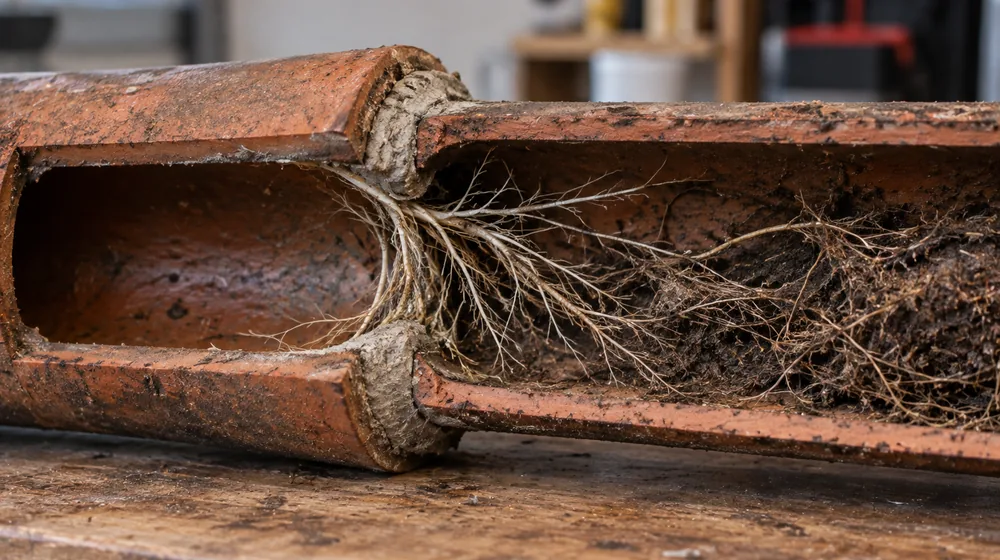
Roots do not break into a healthy pipe. They find the joint that is already leaking. Understanding that single fact tells you why cutting them out is maintenance rather than a repair.
The three conditions, and why Oregon has all of them
A leaking joint. Clay tile laid in short segments with mortared joints is the classic host, and it is what most pre-1960s Oregon laterals are made of. Every joint becomes a potential entry point once it shifts even slightly.
Aggressive shallow-rooting species. The ornamental plums, cherries, birches and maples planted along Oregon residential streets through the mid-twentieth century are prolific shallow rooters. Douglas fir and big-leaf maple do the same at greater scale. A willow or poplar near a lateral is close to a guarantee.
A moisture gradient to follow. A sewer lateral carries warm, moist, nutrient-rich vapour. In a dry Oregon August that plume is the most attractive thing in the entire soil column.
Once a hair root is inside, it thickens in the flow, catches paper and solids, and becomes a dam. The line then runs fine for months and backs up hard, usually at the worst moment.
How far roots actually travel
Homeowners routinely dismiss root intrusion because the nearest tree is thirty feet from the pipe. That reasoning does not hold.
A mature tree's root system commonly extends two to three times the radius of its canopy, and the fine feeder roots that enter sewer joints are the outermost part of that system. A big-leaf maple with a forty-foot spread can have roots working sixty feet from the trunk. The neighbour's tree is a legitimate suspect, and so is a tree that was removed years ago if the stump was ground rather than excavated.
Roots also follow the path of least resistance, which is very often the trench your sewer lateral was laid in. Backfilled trench soil is looser than undisturbed ground around it, so roots preferentially grow along the pipe run — arriving at every joint in sequence rather than crossing at one point.
This is why the answer to "which tree do I remove" is usually unsatisfying. By the time roots are inside, multiple sources may be contributing, and removal does nothing about the joint that is already open.
Which Oregon species cause the most trouble
| Species | Risk | Why |
|---|---|---|
| Willow | Extreme | Actively water-seeking, fast-growing, shallow. Worst possible neighbour for a lateral. |
| Poplar / cottonwood | Extreme | Aggressive shallow systems, very fast growth, common along Oregon waterways. |
| Ornamental plum / cherry | High | Planted extensively in mid-century Oregon parking strips, directly over laterals. |
| Big-leaf maple | High | Native, very large mature spread, dense fine root mass. |
| Birch | High | Shallow rooting, moisture-seeking, common in 1970s Oregon landscaping. |
| Douglas fir | Moderate | Deep taproot reduces lateral spread, but sheer scale still reaches pipe. |
| Japanese maple, dogwood | Low | Small, slow, shallow-spreading. Rarely implicated. |
Before you act on this table: species matters far less than pipe condition. A willow over sound PVC causes no problem at all. A dogwood over cracked century-old clay eventually will. The tree is the opportunist; the open joint is the cause.
How to recognise roots rather than an ordinary clog
- It recurs roughly annually, often in late summer or during the first heavy autumn rains.
- The blockage is always at the same footage. Roots colonise a specific joint; a random clog does not recur at exactly 42 feet.
- White fibrous material comes back on the cable. That is not debris, that is root.
- A greener, faster-growing strip of lawn traces the line's path. The roots are being fertilised.
- Toilets gurgle with no other symptom, as air forces past a partial obstruction.
The seasonal timing is the most useful signal and the most consistently overlooked. In the Rogue Valley, where summers are genuinely dry, root pressure peaks in August and September because the lateral is the only reliable moisture in the soil. In the Willamette Valley the peak often shows in October and November instead, when infiltration adds volume that the already-narrowed line cannot carry.
What actually happens on a root job
Confirm it is roots
Symptom pattern plus what comes back on the cutter head. Guessing wastes a trip and a cutter.
Cut to full pipe diameter
A cutter head sized to the line, not one head for every job. A partial cut restores flow but leaves most of the mass, and the interval before recurrence is correspondingly short.
Jet the debris out
Where pipe condition allows. A cutter shears the mass; jetting removes the fine hair the cable rides past and flushes fragments toward the cleanout rather than leaving them to re-lodge downstream.
Camera the cleared line
This is the step that turns a service call into information. You see which joint is the entry point, at what footage, and at what depth.
Get both paths priced
A maintenance interval, and a lining quote. Including the one that costs the contractor recurring revenue.
Log the footage
If you choose maintenance, the next visit starts at the right place instead of rediscovering it.
Cut forever, or line once
| Cut and jet on a schedule | Line the pipe once | |
|---|---|---|
| Up-front cost | $275–$650 per visit | $8,000–$18,000 |
| Frequency | Every 1–3 years, indefinitely | Once |
| 10-year cost | $1,600–$4,500 | $8,000–$18,000 |
| Emergency backup risk | Remains between services | Effectively removed |
| At resale | A disclosed recurring issue | A documented capital improvement |
| Best when | Pipe otherwise sound; you may move | Staying put, or pipe has other defects |
On pure ten-year arithmetic, maintenance wins comfortably, and it is a perfectly rational choice if the pipe is otherwise sound and you do not expect to own the house in a decade. Anyone telling you that lining is always the right answer is not doing the maths.
It stops being rational at three specific points. When the camera shows the joints are also cracking, so you are maintaining a pipe that is failing structurally regardless of roots. When the intervals are shortening each cycle, which means the joint opening is enlarging and the trend is against you. And when one emergency backup plus its cleanup would cost more than the lining premium — which, for a finished basement, it comfortably would.
What does not work
Removing the tree. Many Oregon cities protect street trees and larger private trees, and removal permits for a healthy specimen are frequently denied. Portland and Lake Oswego are both strict on this. More importantly, removal does not repair the joint that is already open, and a decaying root mass can leave voids in the soil around the pipe.
Root-killing foams. Copper sulphate and dichlobenil products slow regrowth when applied after a mechanical clearing. They do not clear an existing blockage, they do not repair the joint, and some Oregon jurisdictions restrict what may be introduced into the sanitary sewer. Treat them as a delay tactic with a known ceiling, not a cure.
Rock salt down the toilet. A persistent internet suggestion. It does not reach the roots in meaningful concentration, it corrodes metal components on the way, and in older systems it can damage the treatment process. Skip it.
Lining only the affected section when the rest of the run has the same joint construction. Roots will simply find the first unlined joint past the liner's end. If the whole run is jointed clay of the same era, line the whole run.
See rooter service for how cutting is done, and sewer line repair for what lining involves.
Planting so this does not happen again
If you are landscaping, or replacing a tree that has been removed, a little planning avoids repeating the problem for the next owner.
Locate the lateral first. A camera inspection with a surface locate paints the line's path and depth on your lawn for a few hundred dollars. Planting blind over an unknown run is how this cycle starts.
Keep aggressive species well clear. A rough working rule is to plant no closer to the lateral than the tree's expected mature canopy radius, and to treat willow, poplar and cottonwood as unsuitable anywhere near a sewer run regardless of distance.
Favour small ornamentals near the line. Japanese maple, dogwood, vine maple and serviceberry are all well-behaved and suit Oregon conditions.
If the pipe is already lined or replaced in PVC or HDPE, this concern largely evaporates. Jointless modern pipe gives roots nothing to enter, which is a genuine and underrated benefit of doing the repair properly rather than maintaining indefinitely.
Who pays when it is the neighbour's tree
This comes up constantly and the answer disappoints people.
In practice, the sewer lateral is your property and its maintenance is your responsibility, regardless of whose tree the roots came from. Oregon follows the general rule that a property owner may cut back roots and branches that encroach onto their land, but that is a right to trim, not a right to be compensated. Recovering costs from a neighbour normally requires showing negligence — that they knew of a specific hazard and unreasonably failed to act — which is a high bar for a tree that is simply growing.
Two things are more productive than pursuing it. First, check your homeowner's policy for a service line endorsement, which many Oregon carriers sell cheaply and which covers buried lateral repair from ordinary causes including root intrusion. A surprising number of homeowners already have one. Second, if the tree is a street tree in the public right-of-way, contact the city — responsibility there is genuinely different and worth establishing before you spend anything.
None of this is legal advice, and if the sums are large enough to matter, an hour with an Oregon property attorney is cheaper than guessing.
Services mentioned in this guide
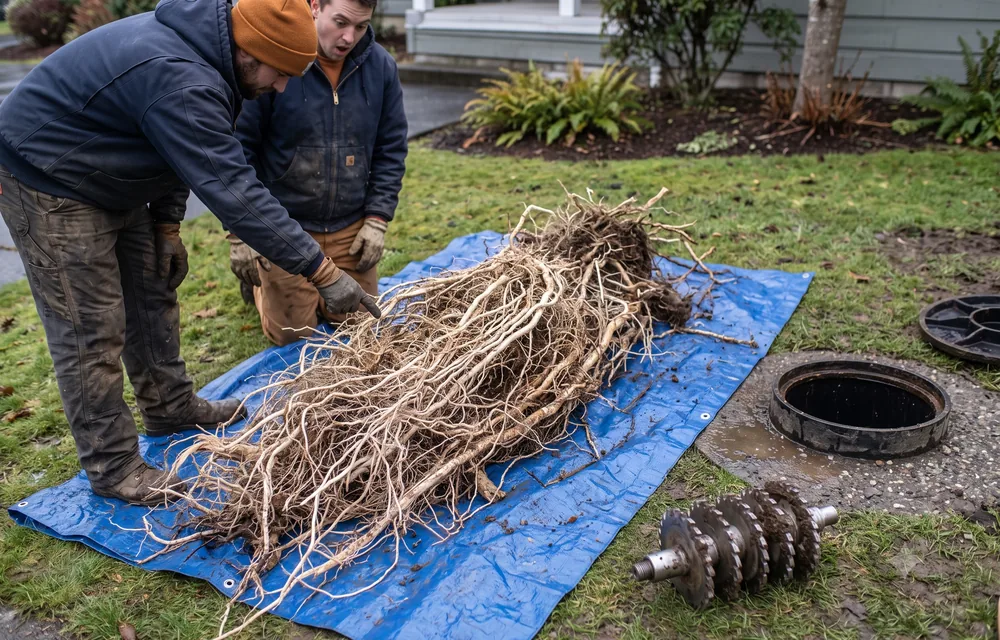
Rooter Service & Tree Root Removal
Roots do not break into a healthy pipe.
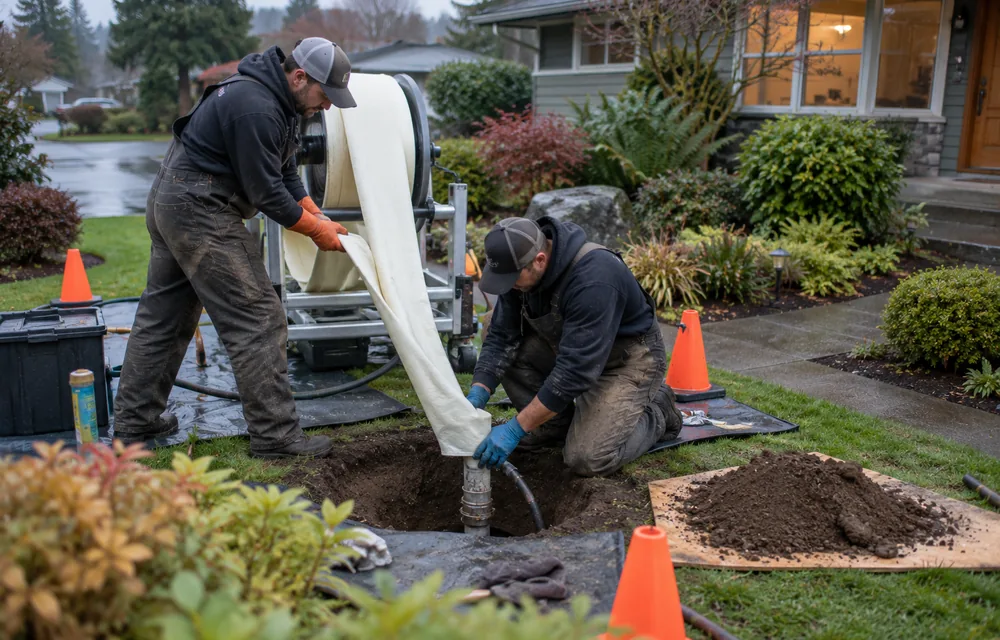
Sewer Line Repair & Replacement
Sewer replacement is the largest unexpected bill most Oregon homeowners ever face on their plumbing.
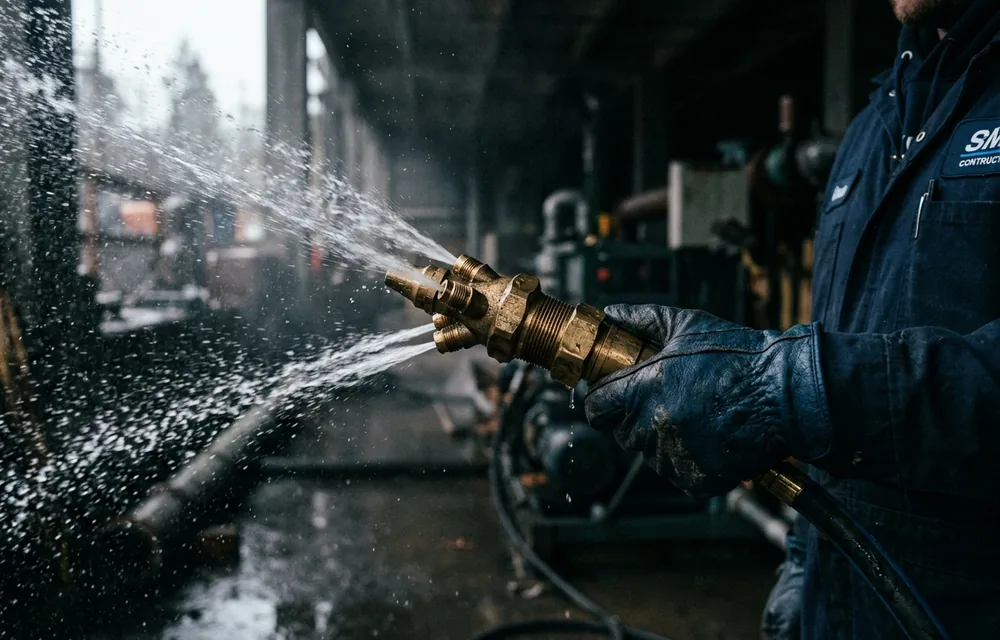
Hydro Jetting
A cable bores a hole through the clog.
More guides
How to Unclog a Drain Yourself (and When to Stop)
Most single-fixture clogs are genuinely a DIY job. Here is what works, in the order a plumber would try it — and the p…
Sewer Backup: What to Do in the First Ten Minutes
A main line backup gets measurably worse with every gallon of water the household uses. What you do in the first ten m…
Winterizing Plumbing in Oregon: A Regional Checklist
Generic winterizing advice is written for the Midwest and it is either overkill or dangerously inadequate depending on…